of eligible employees reached Choose during open enrollment.
Nayya · Growth / B2B2C · 2024–25
From completion
to guidance.
I reframed a survey-completion problem as a top-of-funnel value problem, then led a relaunch that made useful guidance available before commitment.
RoleProduct Design LeadStrategy, research, product design, and validation
PartnersMarketing · Product · EngineeringInternal stakeholders and a client research team
Research24 concept interviews16 employees and 8 employers, plus ~150 Pendo and 300+ survey responses
ScopeFront door → guidanceOpen-enrollment entry, decision support, and recommendation access
01 / Find the real leak
The survey was not failing at completion. Most employees never saw enough value to begin.
Choose served as Nayya’s flagship entry point during open enrollment, reaching a potential population of approximately two million employees. It also produced information used across recommendations and the broader personalization strategy.
Once employees started, roughly 80% finished. The more consequential loss happened before and immediately after exposure, while employees were deciding whether Nayya was relevant at all.
of exposed employees began the survey when exposure was high.
of employees who started completed the flow.
followed supplemental-plan recommendations.
Original optimizationGet more people through the survey.
Strategic reframeDeliver useful guidance before asking for commitment.
02 / Leadership and leverage
The relaunch was not on the roadmap. Evidence made it difficult to ignore.
With resources moving toward new verticals, Choose was not scoped for the quarter. I partnered with the Director of Marketing to connect the funnel to renewal risk, product utilization, recommendation adherence, and revenue.
We brought the case through Nayya Labs, turning a broad backlog into a focused incubation and earning leadership alignment around the front-door opportunity.
Locate the business-critical leak.
Connect exposure, engagement, adherence, and employee sentiment.
Make the opportunity consequential.
Position Choose as an entry point, data source, and renewal risk.
Earn room to experiment.
Use Nayya Labs to align leadership around focused incubation.
03 / Evidence, not ritual
Analytics showed where people left. Research explained why.
Concept tests, an in-product Pendo test, and a national survey read as one evidence system — which intervention could change the funnel without eroding trust.
16Employee concept interviews
8Employer interviews
~150Pendo respondents
300+Survey responses
Purpose was unclear.
Employees often skipped Nayya after the HR email because they did not understand what it would do for them.
Most people reuse last year’s choices.
54% were likely to treat prior selections as a shorthand. The first decision was whether a new decision was even needed.
Speed without losing a say.
Quick Recommendation ranked high (35% Pendo; 59% survey interest), but demographic-only inputs felt untrustworthy. People still wanted some ability to influence the answer.
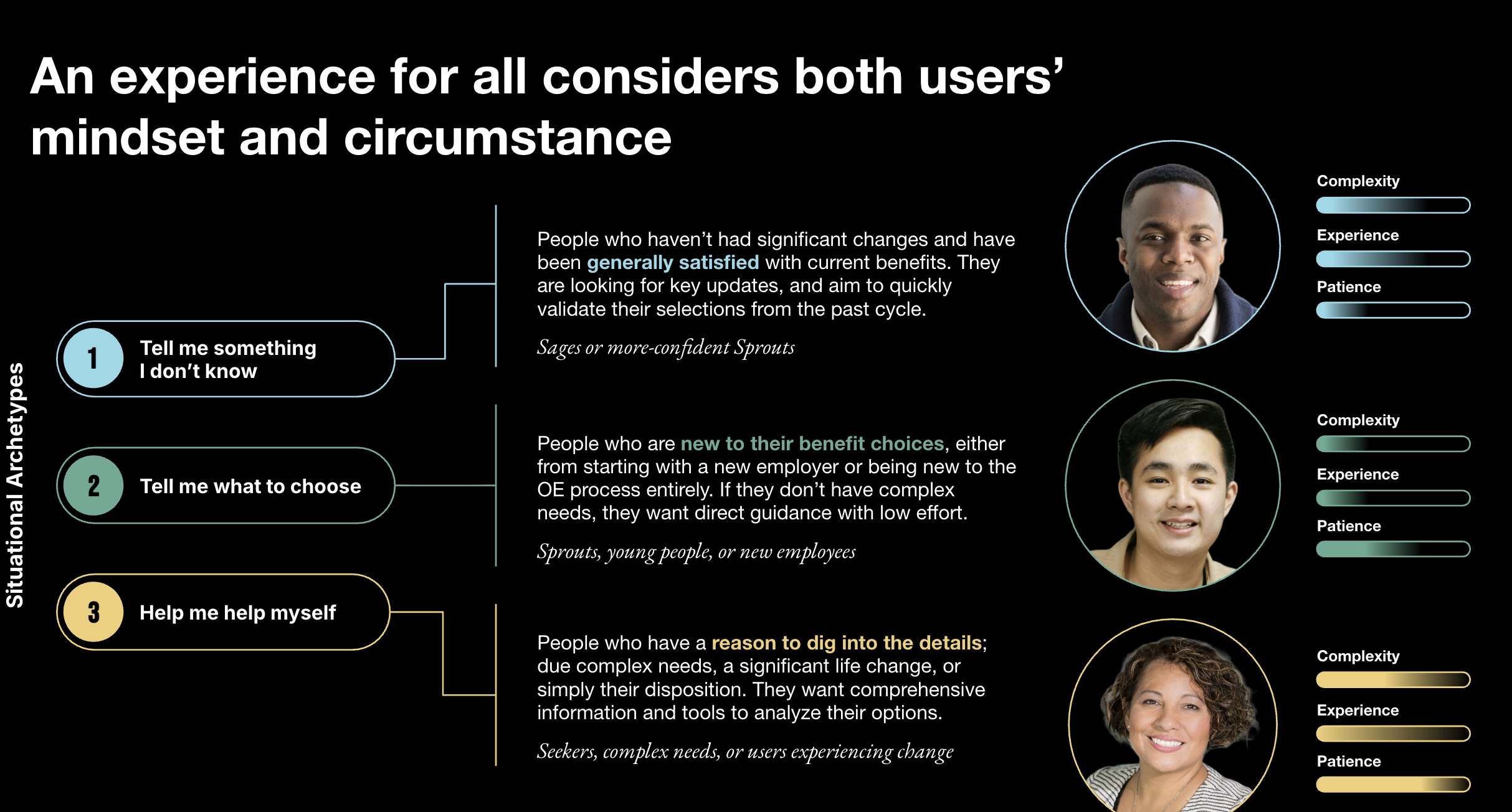
One path cannot serve every mindset.
Needs ranged from quick validation to deep analysis. Progressive disclosure — Choose-for-all — fit better than a single survey-first route.
From findings to bets
Opportunities became product recommendations.
Skippers got zero Nayya value
Interim step for skippers
Prove value with comparison and a path to personalize — don’t let skip mean zero Nayya value.
Efficiency without empty personalization
Quick recommendation
Offer an efficiency path from partial input, without pretending demographics alone are enough.
Lead simple, allow depth
Layered recommendation
Lead with a clear summary; open deeper detail when people want it.
Compare was buried too late
Earlier compare
Make plan comparison available from survey and from both quick and full recommendation summaries.
04 / Pivotal decision
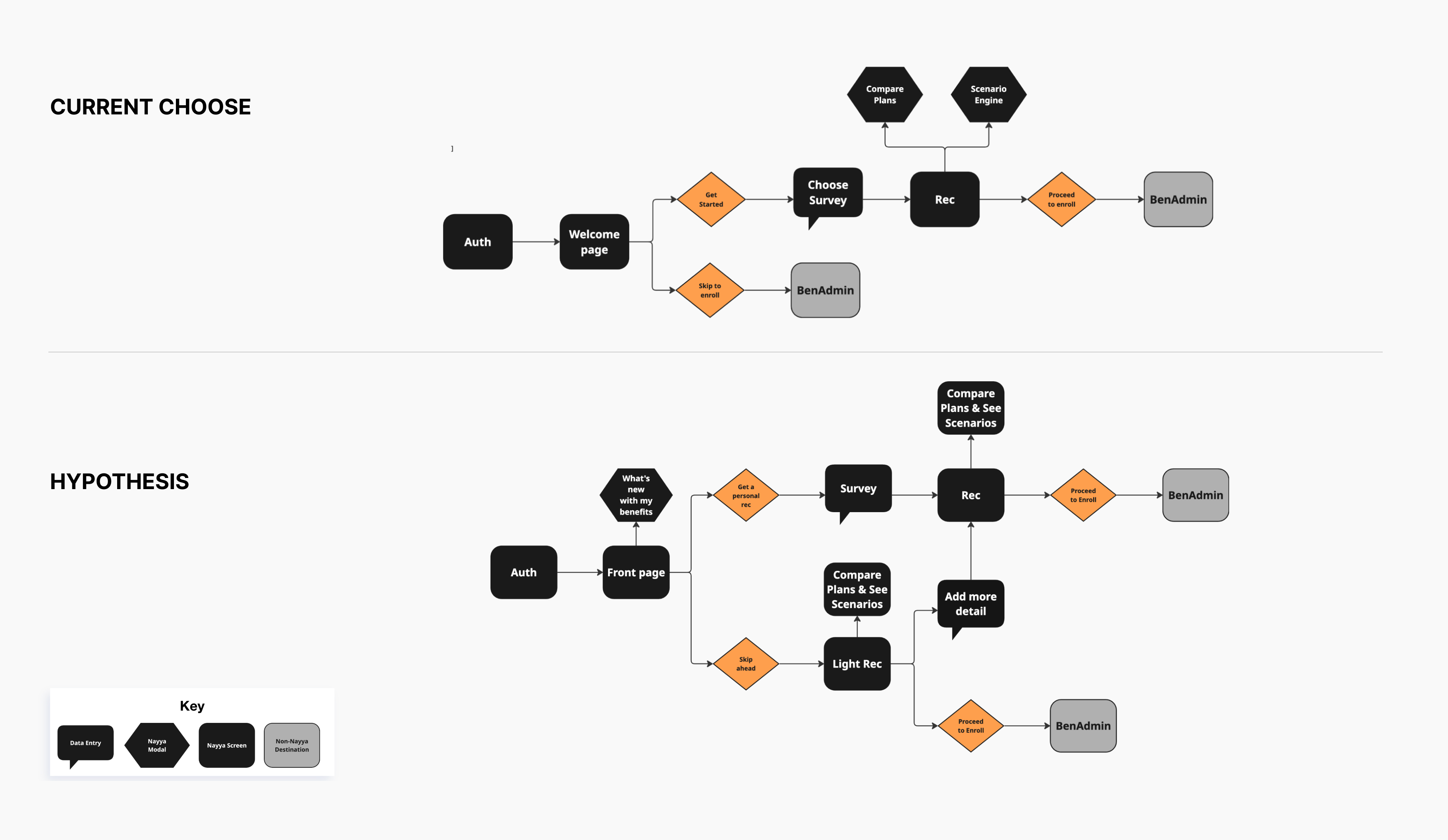
Replace one required path with several routes to value.
Choose was built like a completion problem. Finish the survey, get a recommendation. Fewer than 20% of eligible people even opened it. The obvious move was to shorten the survey and push conversion. We did not. The survey stayed available as depth, not as the front door. Guidance, comparison, education, and scenarios became visible first.
Starting modelSurvey first
New directionChoose the useful next step
05 / The experience
Earn attention before asking for effort.
Let need determine the path.
Recommendations, comparison, education, and scenarios no longer depend on one linear survey.
Surface change before the ask.
Call out plan and feature changes so people who reuse last year still have a reason to look.
Give skippers a real answer.
An efficiency path still returns a recommendation — not a straight exit to BenAdmin.
Make depth available on demand.
Detailed comparison and scenario costs sit beside the recommendation when people need to dig.
06 / Evidence and outcome
The relaunch changed both utilization and how the company defined meaningful engagement.
Increase in utilization following the relaunch.
More eligible employees entered and engaged with the experience.
Increase in supplemental health sales following the relaunch.
of users interacted with guidance from the new front door.
07 / What the relaunch exposed
Less effort created access. It did not automatically create relevance.
The first light recommendation made guidance easier to reach, but thinner context pushed the product toward broader assumptions. That sat uneasily with Nayya’s core: know enough about someone and their needs to recommend accurately from real data. When we reduced what we collected to raise engagement, the recommendation could get weaker. The next design problem followed directly: when does the system know enough to help, and when does it need to ask?