Funnel and sentiment
More people reached guidance, and the experience felt easier to understand.
After the relaunch, an engineer and I escalated a recommendation-integrity gap to the CPO. Demographic-only light recommendations improved access but could not meet the accuracy standard Nayya needed. I led the product model that followed—grounding guidance in recognizable life situations and preparing it for approximately 20 client groups this Open Enrollment.
NPS and engagement suggested the new front door was working. Internally, we could see a harder truth: the light recommendation relied on broad demographic assumptions and could suggest coverage without enough context to know whether it was appropriate.
More people reached guidance, and the experience felt easier to understand.
Age and household data could establish eligibility, but not intent, anticipated care, or financial priorities.
Recommendation integrity mattered more than protecting a favorable short-term metric.
An engineer and I brought the problem to the CPO: recommendation accuracy could not be traded for a cleaner funnel.
I reviewed the survey questions and existing data points that materially changed different recommendations, then grouped recurring signals into early persona hypotheses.
I took the model to Product and Engineering to confirm which inputs were reliable, available, and consequential enough to affect the recommendation.
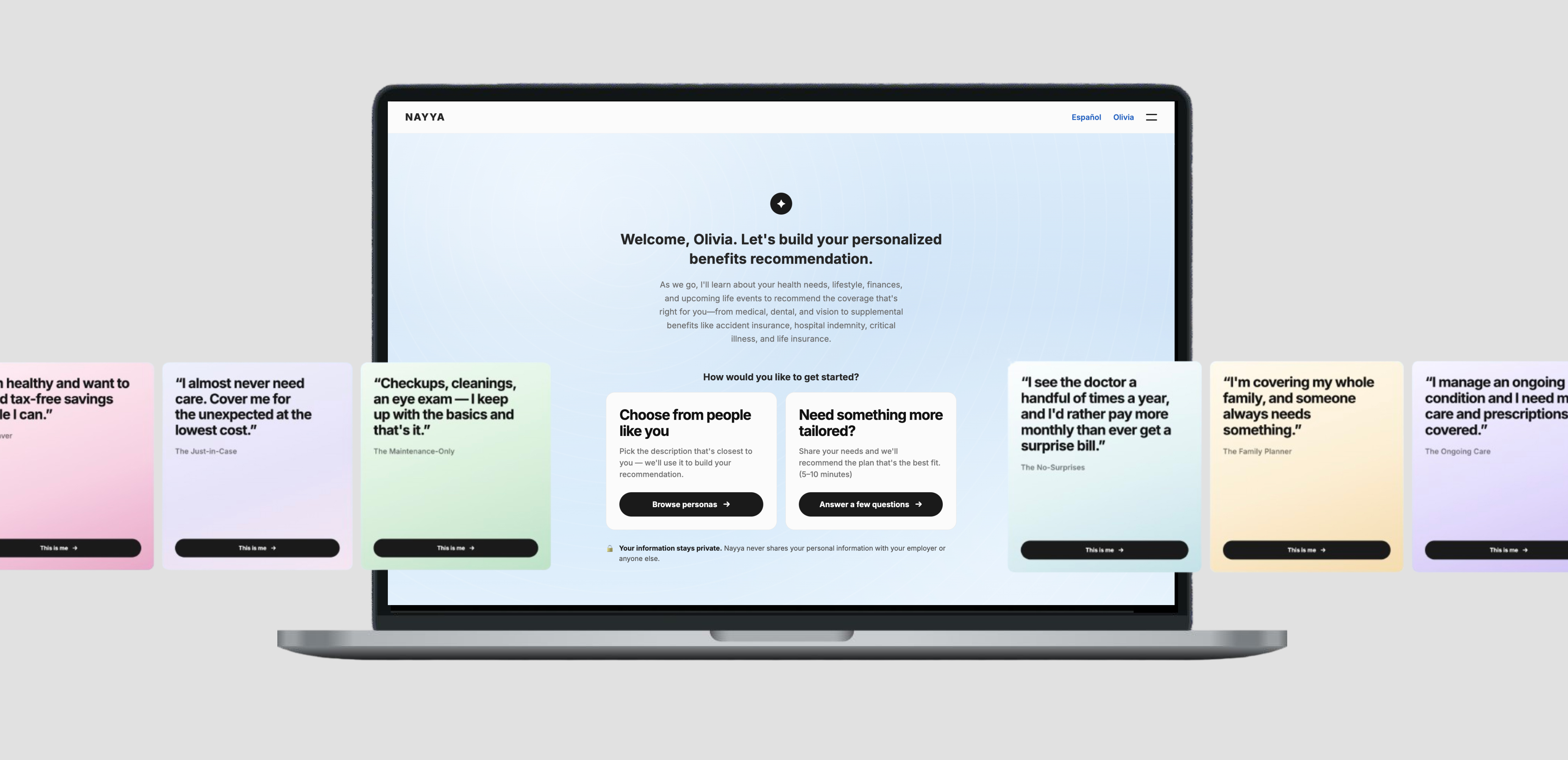
Across recent Relaunch research and years of Choose research, people repeatedly described asking friends, coworkers, or family members who had navigated similar situations. I proposed that recognizable, scenario-based personas could provide a more human way into the recommendation logic.
People sought advice from others with familiar needs or life circumstances.
I isolated the survey inputs that materially affected recommendation direction.
Product and Engineering helped refine the data points and validate the model.
I translated the model into the persona selection and guidance experience.
When the system still lacked sufficient context, the experience connected users to the full survey.
Choose was built to block no one. Demographic-only light recommendations raised access. They also recommended coverage the system could not defend. The obvious move was to protect the new metrics. We did not. We put recognizable situations and targeted questions in front of the recommendation, knowing some of the funnel might come back off.
Protect the standard that guidance should be grounded in enough context to be defensible.
Use context already known and ask only when an answer could materially change.
Prepared for production rollout during the October–November enrollment period.
We were willing to trade some short-term metrics for recommendation fidelity. That did not mean accepting a dead funnel. Alongside the integrity model, we placed three design hypotheses into the test to keep engagement from collapsing.
Feedback had called the product outdated and rigid — classic B2B2C SaaS. With CTO approval, the integrity test also carried a light visual and interaction refresh that borrowed more from contemporary AI and D2C patterns, aimed at making the experience feel current enough to engage.
Fancy persona names ask people to learn a character. Instead, each path led with a single quote meant to land immediately. Eligibility and situation came from what we already knew demographically — age group, marital status, and similar signals — so the persona stayed simple on the surface and grounded in real context underneath.
By then Titan’s AI-native infrastructure existed, even though client rollout was on hold. I connected the end of this experience into the AI chat so people could keep asking questions inside the ecosystem. That also gave legacy clients a lighter path toward Titan as an add-on — engagement first — instead of only a full implementation sell.